Google Business Profile views are falling. But what really changes for stores?
Since 22 September 2026, views of Google Business Profiles in Search have collapsed: -59% on mobile and -53% on desktop, across a sample of European brands from different sectors. And yet, over the same period, the concrete actions taken by customers have not declined. Quite the opposite.
Anyone managing the local presence of a retail network could look at the Google dashboard and conclude that visibility has dropped sharply. But the numbers, read as a whole, tell a different story. In this article we look at what happened, how to interpret it and which indicators to focus on from now on.
The numbers: views down, actions up
At first glance the headline figure is worrying: the presence of store profiles in Google Search appears to have halved overnight. But alongside this drop there are other signals, pointing the other way.
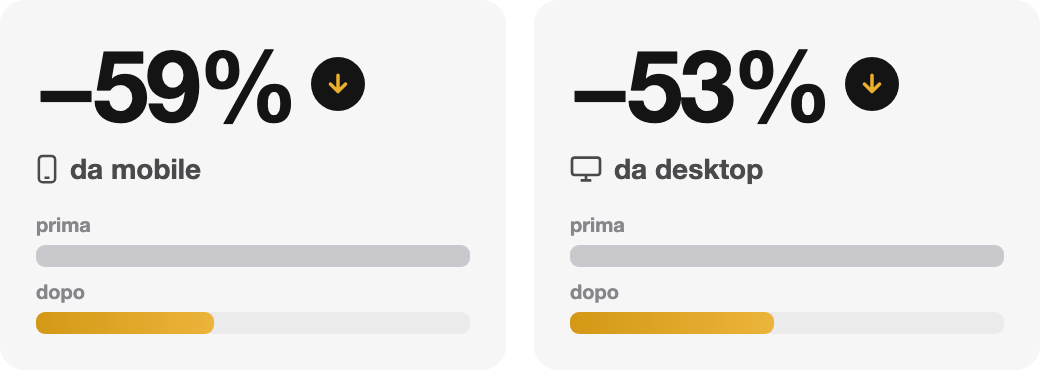
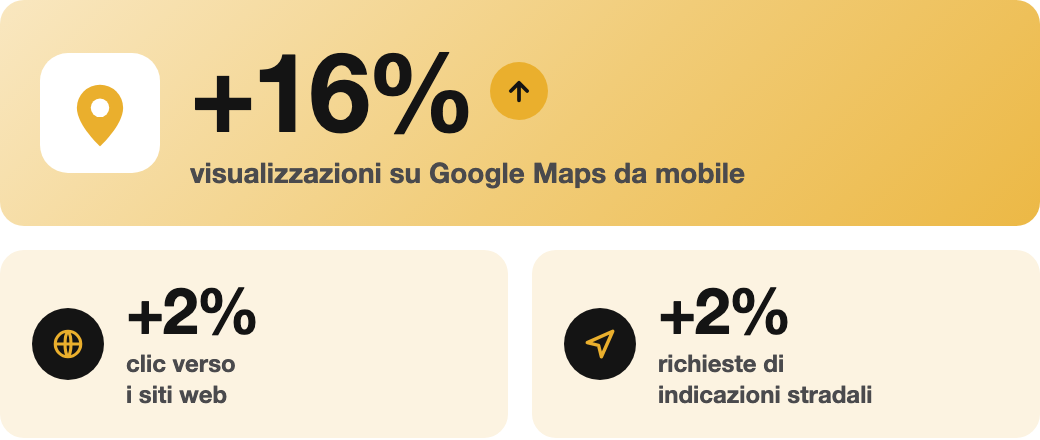
In short: fewer people “see” the profile in Search, according to Google’s own data, but more people view it on Maps and slightly more take a concrete action towards the store.
Less visibility, or a new way of measuring it?
If stores had genuinely become less visible, we would expect clicks, calls and requests for directions to fall as well. Instead actions are holding and growing slightly. This suggests that the collapse concerns the way views are counted, rather than how customers actually behave.
There are two plausible explanations, and they are not mutually exclusive:
- A change in measurement. Google may have changed the criteria by which it counts a “view” in Search, for example by no longer recording the most marginal or repeated appearances. Google has revised these metrics before, with similar effects on reports.
- A change in the search journey. Results pages keep evolving, including answers generated by artificial intelligence, and more and more users go straight to Google Maps to look for a nearby store. The +16% in Maps views from mobile points in that direction.
In both cases the practical conclusion is the same: a drop in views does not automatically mean a drop in business opportunities.
Why actions matter more than views
A view tells you that a store’s profile appeared on someone’s screen. It does not tell you whether that person noticed it, was interested in it, or ended up walking into the store.
Actions, on the other hand, measure concrete intent: someone asking for directions is considering reaching the store, someone clicking through to the website wants to know more, someone calling has a specific question. This is where the link between digital presence and store traffic is played out.
This is why the real value of a Google profile is not measured by how many times it is shown, but by how many people choose it and take an action.
Which indicators to watch from now on
Comparing views before and after 22 September risks being misleading. It is better to shift attention to metrics that sit closer to the business result:
- Requests for directions, the most direct signal of an imminent visit.
- Website clicks and calls, to understand how far the profile feeds interest in the brand.
- Google Maps views, increasingly central to the journey of anyone looking for a nearby store.
- Action rate, that is the ratio between actions and views: with fewer views counted and stable actions, the quality of the presence looks higher.
For comparisons over time it is worth using the data after 22 September 2026 as a new baseline, or comparing actions year on year, since those are unaffected by the change in how views are counted.
What to do in practice
If every view counts for more, every profile has to convert better. Some priorities for retail networks:
- Always up-to-date data. Opening hours, public holidays, special openings and services must be correct: one wrong piece of information turns a potential visit into a lost customer.
- Profiles curated for Google Maps. Recent photos, precise categories, attributes and descriptions written for people looking for a store near them.
- Reviews managed consistently. Replying to reviews and encouraging new ones helps people choosing between several stores.
- Local posts and promotions. News, events and offers give people one more reason to drop into the store.
- Continuous monitoring. Google’s metrics change: they need to be read regularly and as a whole, to tell a real problem from a change in the reports.
Claudio Agazzi’s point of view
On 18 September Google documented the extension to European local searches of the new panels dedicated to aggregators and business websites. A change that may have affected the visibility of individual Google Business Profiles in search results.
In my view, for a store Google Maps is worth far more than simply appearing in a list of results on the search page.
On Maps a person can check the opening hours, call the store, read the reviews or start navigating towards it. It is the step from search to action that, in my opinion, determines the real value of a store’s digital presence.
The fact that in some cases those actions have actually increased while views in Search were falling reinforces this reading.
At RetailTune we are also seeing organic growth in traffic to Store Locators, another interesting signal. The pages dedicated to individual stores are a direct link between online search and the physical shop, offering information, services and opportunities to interact.
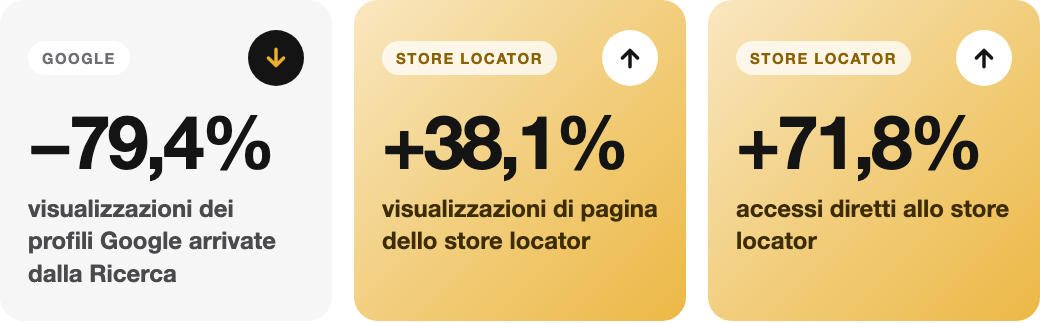
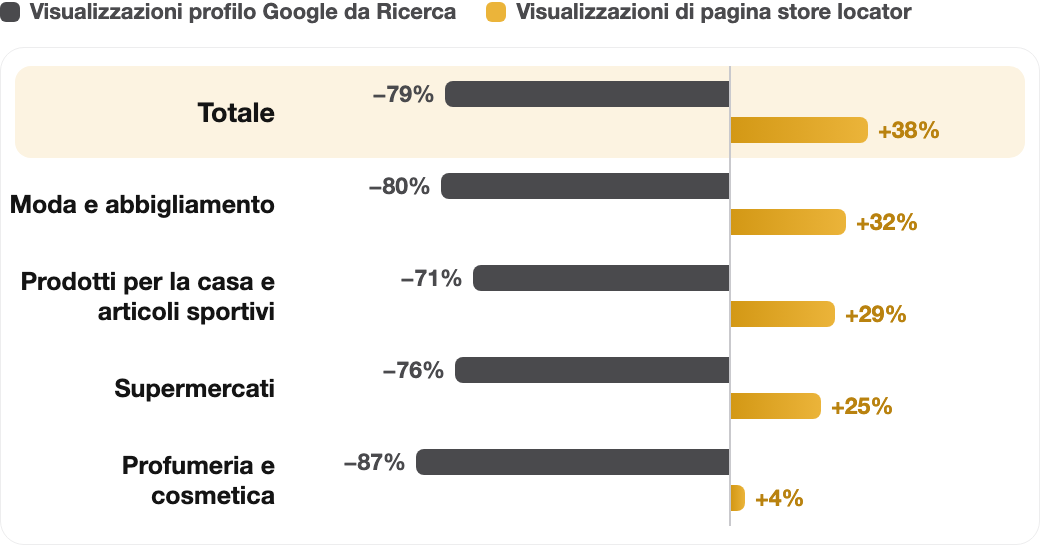
So I believe that, to assess the impact of these changes on retail brands properly, we need to go beyond the simple number of views.
The questions we should be asking, including city by city, are essentially two: is the store still being found by people searching for a product, a brand or a category? And, once found, how many people take a concrete action?
Because a drop in views does not necessarily mean a drop in business opportunities.
And perhaps the most interesting change is exactly this: learning to tell how often a store is shown from how well it actually gets chosen.

In conclusion
The drop in Google profile views should not be ignored, but nor should it be read as an isolated alarm signal. The data from the sample shows that, while views in Search fall, Maps grows and customer actions remain solid.
At RetailTune AI we constantly monitor these developments and their impact on the visibility of and traffic to physical stores. Our goal is to help brands look beyond surface numbers, and focus on what really matters: the people who choose a store and decide to go there.
Want to know how the visibility of your stores is changing?
Get in touch for a dedicated analysis of your store network.